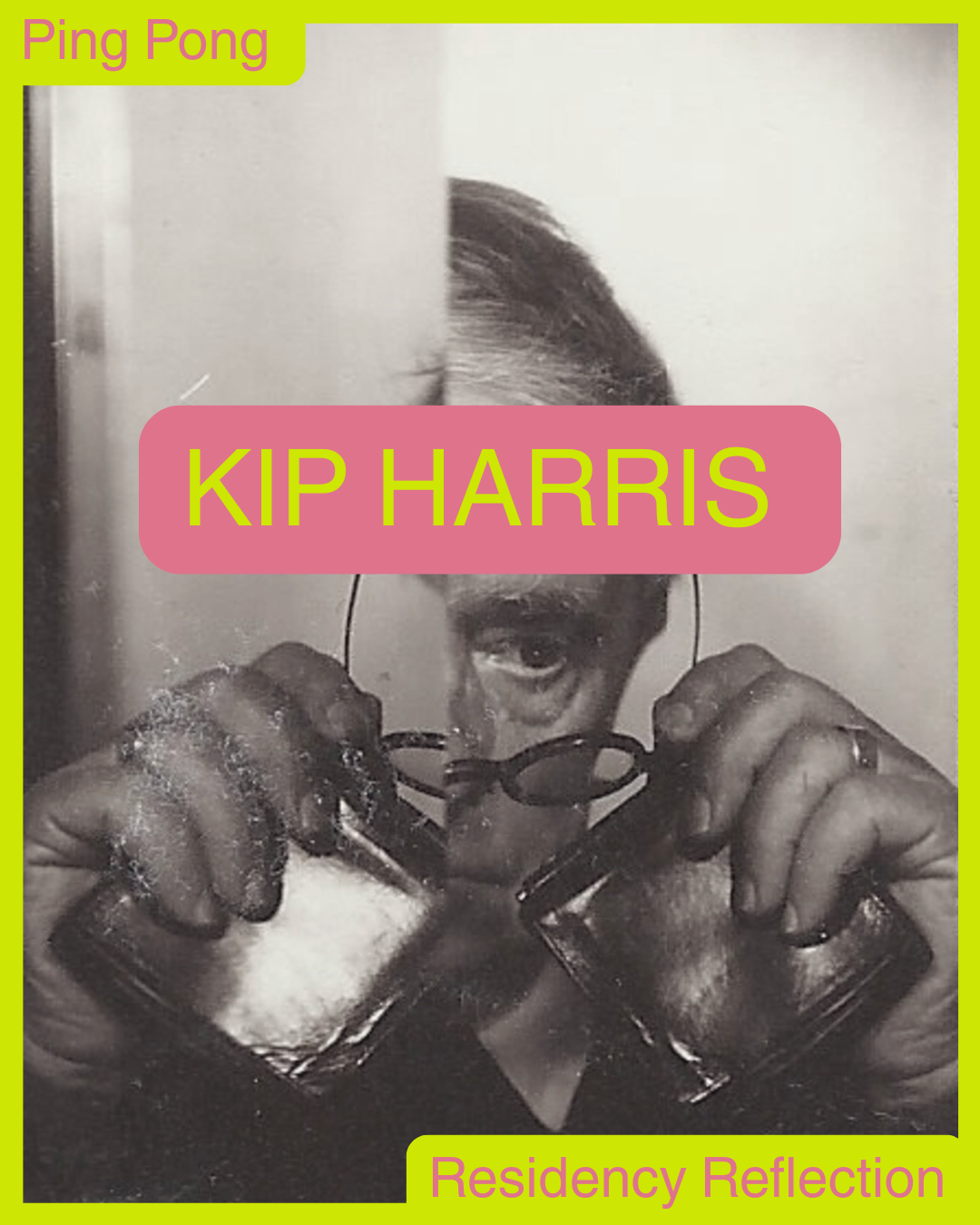
Residency Reflection: Kip Harris
My time at ping-pong began before I set foot in Berlin, with a detour to a Mark Rothko retrospective in Florence, part of it installed inside the Convento San Marco. Going back through those images later, I noticed what I'd been doing: making self-portraits as shadows and reflections, in the manner of Lee Friedlander and Vivian Maier. In one monk's cell, my shadow fell across a small Rothko hung beside a Fra Angelico fresco of similar palette. In another, I'm faint in the background of a portrait of Savonarola, the friar famous for the "bonfire of the vanities."
That accident in Florence set the tone for everything that followed. Jacqueline had warned me that straight street photography would be hard in Berlin — people there are guarded about their images, wary even of permitted photos being misused. So I fell back on an old habit: walking the streets not to photograph people head-on, but to look for strange juxtapositions and analogies. That habit became the real subject of the residency.
I kept finding myself folded into the frame rather than standing outside it — in a photographer's studio window in Bötzowviertal, in the mirrors of a barbershop inside a U-Bahn station, in a laundromat that happens to be named Ping-Pong, and upside down in a Georg Jensen silver bowl at KaDeWe, so reflective it swallowed the whole store.
Two portfolios grew alongside this: portraits of people at work — mostly construction workers, the only people I could openly photograph — and portraits inside subway cars, shot on a silenced iPhone. That second one pushed me somewhere new: away from my usual environmental portraiture and toward isolating people from their surroundings, in the tradition of Strand, Lartigue, Davidson, Evans, and Maier. I also added to a long-running barbershop portfolio, catching two more in Berlin.
Looking back, I think the residency gave me less a set of finished images than a method: when the direct approach is closed off, look sideways — at what's reflecting, what's adjacent, what the city shows you without meaning to. Now the real work starts: figuring out what these two cities, and the version of myself caught in their windows and mirrors, add up to.